From Idea to Reality: How Environmental Test Chambers Strengthen Products in India
Every product starts as an idea. It goes through design, development, and production—but one stage often determines its long-term success: testing.


Every product starts as an idea. It goes through design, development, and production—but one stage often determines its long-term success: testing.
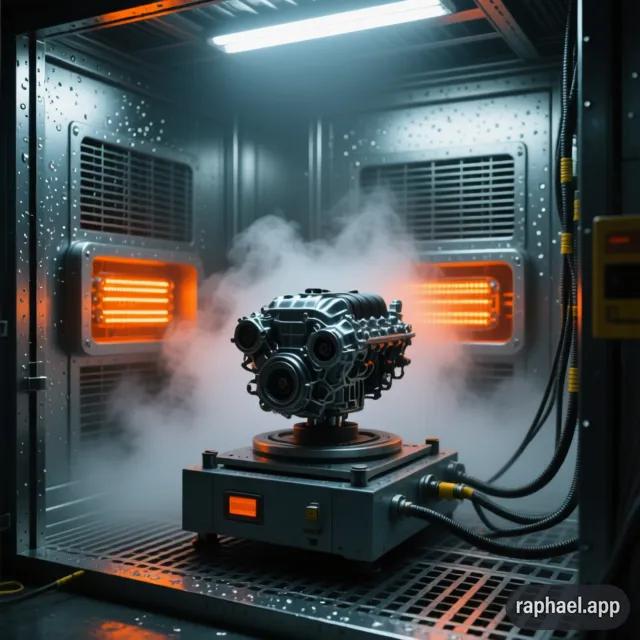
Products rarely operate in perfect conditions. They face heat, cold, moisture, dust, and many other environmental challenges throughout their lifecycle. To prepare products for these realities, manufacturers use environmental test chamber to recreate natural conditions inside a laboratory and study how products respond.
Environmental test chamber in India are used to test products under controlled conditions like extreme temperature, humidity, dust, and corrosion. These chambers help manufacturers evaluate how materials and components will perform in real environments.
In today’s competitive manufacturing environment, speed and precision are essential. Injection moulding robots help plastic manufacturers meet these demands by automating critical tasks around the moulding machine. From part removal to inspection and packaging, these robots ensure consistent output while improving workplace safety and overall efficiency.
Indoor comfort is no longer a luxury—it is a necessity. Whether in homes, workplaces, or industrial facilities, controlling temperature and air quality plays a major role in comfort and health. HVAC is a commonly used term in this field. Understanding the HVAC full form and its function makes it easier to appreciate how modern buildings maintain ideal indoor conditions.
In hot weather, air conditioning systems must handle both excess heat and excess moisture. The psychrometric air treatment process explains how air properties change inside an AC system to achieve comfortable indoor conditions. This process forms the foundation of summer HVAC operation.
In today’s global marketplace, quality is no longer a differentiator—it’s a baseline expectation. For Indian manufacturers aiming to compete internationally, the real advantage lies in delivering products that perform consistently across unpredictable environments. This is where environmental test chambers are making a measurable impact.
As Indian manufacturing moves toward higher precision and global competitiveness, quality testing has become a core requirement rather than a final checkpoint. One of the most important tools supporting this shift is the Environmental test chamber in India. These systems help manufacturers validate product performance by recreating real-life environmental conditions inside a controlled laboratory setting.
As manufacturing moves toward higher speed, precision, and consistency, automation technologies are evolving rapidly. Among these advancements, top entry robots have become a preferred solution for manufacturers seeking efficient part handling, in-mold labeling (IML), and assembly operations. Their vertical entry design makes them ideal for space-saving, high-speed production environments.
As Indian manufacturers expand into global markets, meeting international quality and safety standards has become non-negotiable. From automotive exports to electronics and defence production, environmental test chamber in India play a crucial role in validating product reliability under real-world conditions.
Automation is no longer a future concept—it’s a necessity. Among the most widely adopted automation solutions today, pick and place robot stand out for their speed, accuracy, and versatility. From factories to warehouses, these robots are transforming how businesses handle materials and products.
As Indian manufacturing aligns with global quality benchmarks, testing products only at room conditions is no longer enough. From extreme heat in deserts to high humidity in coastal regions, products in India face diverse environmental challenges. Environmental test chamber in India help manufacturers predict real-world performance, making them an essential part of modern quality assurance.
The global food industry is undergoing a major transformation, driven by automation and advanced robotics. From food processing plants to restaurant kitchens, robots are improving efficiency, safety, and consistency. As consumer demand for quality and speed grows, robotics is becoming a vital component of modern food operations.
As Indian industries move toward global markets, product validation has become a critical step in manufacturing. Environmental test chambers help companies simulate real-world conditions and verify product durability, safety, and compliance. Today, the adoption of environmental test chambers in India is growing rapidly across both private and government sectors.
Introduction:Industrial robots are transforming the way factories operate, bringing speed, precision, and consistency to production processes. With advancements in robotics technology, businesses across sectors are leveraging these machines to reduce costs, improve quality, and meet growing consumer demands.
Summer air conditioning is not just about lowering room temperature—it is equally about controlling humidity. Hot and moist outdoor air must be processed carefully to create a comfortable indoor environment. This is achieved through psychrometric processes, which explain how air properties change during cooling and dehumidification in summer conditions.
As industries in India evolve rapidly, the demand for reliable, world-class products has never been higher. Whether it's automotive components, electronics, or aerospace systems, companies need assurance that their products can withstand real-world challenges. This is where environmental test chamber in India become essential.
In today’s fast-paced supply chain landscape, efficiency is no longer a competitive advantage—it’s a requirement. Warehouses are under constant pressure to move products faster, reduce operational errors, and meet rising customer demands. This is where material handling robots are transforming the game.
Maintaining a comfortable, safe, and energy-efficient environment has become a top priority for both residential and commercial spaces. As technology advances, traditional heating, ventilation, and air conditioning systems are no longer enough. Smart HVAC systems are now transforming how buildings manage temperature, airflow, and energy usage.
Industrial robots are no longer a futuristic concept—they are now a core part of modern manufacturing. As industries push for higher productivity, lower operational costs, and improved safety, industrial robots have emerged as the ultimate solution. In 2025, factories worldwide are adopting advanced robotic systems to streamline operations and stay competitive in an increasingly demanding global market.